
Everything you need to know about NYC kindergarten readiness
What You Actually Need to Know About the NYC Kindergarten Readiness Assessment

A kindergarten readiness assessment in NYC is how schools — both public and private — evaluate whether a child is developmentally prepared to enter kindergarten. Here is a quick overview of what that looks like:
In NYC public schools:
Screening is required by New York State law (Part 117)
Must happen before December 1 or within 45 days of enrollment
Covers health, language, cognitive, motor, and social development
Uses tools like the ASQ-3; traditional standardized tests are prohibited in pre-K
In NYC private schools:
No standardized test requirement; each school sets its own process
Common formats include in-person interviews, observation playdates, the FLI (First Look Insights) test, and the T&E (Thinking & Engagement) virtual assessment
Schools evaluate language, reasoning, social skills, teachability, and school fit
Results are not shared with parents — only with admissions committees
The stakes feel high — and they are. Four out of ten children score below grade level on kindergarten entry assessments each year. In competitive NYC private school admissions, a single short visit with a four- or five-year-old may be all a school gets before making a placement decision.
This guide walks you through every layer of the process — from regulatory requirements to private school evaluation formats to how you can support your child's readiness without adding pressure.
I'm Bige Doruk, founder of BKAdmissions Inc., and over 17 years of advising thousands of families through competitive private school admissions — including the NYC kindergarten readiness assessment process — I've developed a structured, ethics-first framework to help families position their children well without compromising their well-being. In the sections that follow, I'll break down exactly what assessments exist, what they measure, and what you can do about it.
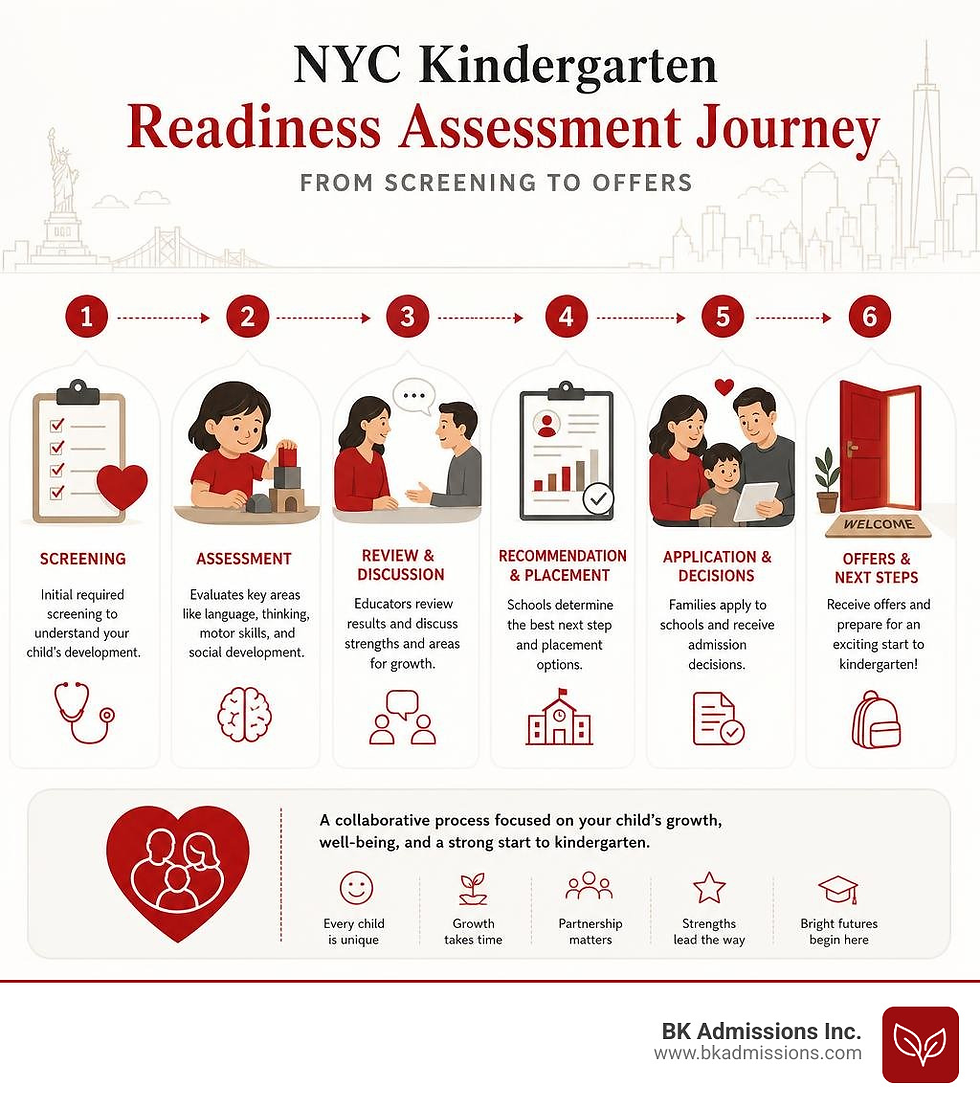
Navigating the Kindergarten Readiness Assessment NYC Landscape
In New York City, the transition to kindergarten is more than just buying a new backpack; it is an introduction to a highly structured educational landscape. The core purpose of any early childhood assessment is to understand where a child sits on the developmental spectrum. By evaluating their baseline skills, educators can identify potential learning differences, speech-language needs, or areas where a student might need extra support.
According to the National Institute for Early Education Research, defining readiness requires looking at the "whole child"—meaning we must look beyond basic academic skills like counting or letter recognition. You can read more about this holistic approach in their research on What is Readiness?.
At BKAdmissions Inc., we often remind families that a readiness assessment is not an "IQ test" or a barrier to entry; rather, it is a tool to ensure your child lands in a classroom environment where they can thrive. As highlighted by WestEd, these early childhood screenings are critical because Kindergarten Readiness Assessments Help Identify Skill Gaps before they impact a child's academic confidence. Navigating this landscape requires understanding the rules of the game in your specific school district, which we detail extensively in our comprehensive Kindergarten Admissions NYC Guide.
Public vs. Private School Kindergarten Readiness Assessment NYC Requirements
The biggest fork in the road for New York families is deciding between public and private school education. The assessment requirements for these two paths are vastly different in both execution and intent.
In NYC public schools, early screenings are standardized, regulated, and focused heavily on developmental screening to identify potential disabilities or English language limitations. In contrast, NYC private schools use readiness assessments as a competitive admissions tool to determine fit, classroom balance, and teachability.
Feature | NYC Public Schools | NYC Private Schools |
Primary Goal | Identify developmental delays, disabilities, or English language needs. | Determine school fit, teachability, social dynamics, and academic potential. |
Mandated Tools | Ages and Stages Questionnaire (ASQ-3). | School-specific playdates, FLI Test, or T&E Assessment. |
Format | Brief, low-pressure activities or parent-completed questionnaires. | In-person child interviews, group play observations, or virtual assessments. |
Standardized Tests | Prohibited in public pre-K and kindergarten classrooms. | Non-traditional, proprietary assessments are common (e.g., FLI). |
Results Shared? | Yes, shared with parents to guide instruction and support. | No, kept strictly confidential within the admissions committee. |
For families considering the independent path, our Private Kindergarten NYC Guide 2026 offers a deep dive into how Manhattan, Brooklyn, and Riverdale private schools structure their admissions processes. Whether public or private, all New York State programs must operate under the guidelines outlined by the Assessment | New York State Education Department, which emphasize using developmentally appropriate, valid, and reliable tools.
Understanding the Four Categories of Early Childhood Assessment
To demystify how schools talk about your child's progress, it helps to understand the four distinct categories of assessment used in early childhood education:
Developmental Screening: A brief, formal procedure designed to identify children who may need special education services or English language support. In public settings, this must occur within 45 days of enrollment.
Baseline Assessment: An in-depth look at a child’s skills at the start of the year. Unlike a quick screening, a baseline evaluation maps out a child's current abilities across literacy, math, and social skills to help teachers tailor their lesson plans.
Progress Monitoring: Ongoing, informal, and authentic evaluations throughout the school year. Teachers collect work samples, take observation notes, and monitor how a child is growing.
Outcome Assessment: A "post-test" administered at the end of the school year (using the same tool as the baseline) to measure overall growth and program effectiveness.
For public pre-K and kindergarten programs, the NYC Division of Early Childhood Education mandates specific guidelines for Developmental Screening and Authentic Assessment. Currently, public programs use the Ages and Stages Questionnaire (ASQ-3) for developmental screening, and approved systems like Teaching Strategies GOLD for ongoing, authentic progress monitoring.
Key Developmental Areas Evaluated in NYC Readiness Screenings

When educators evaluate your child during a kindergarten readiness assessment in NYC, they are not expecting them to read chapter books or solve multiplication tables. Instead, they look at foundational developmental milestones.
Cognitive and Academic Skills: Can the child identify basic shapes and colors? Do they understand one-to-one correspondence (e.g., touching five blocks as they count to five)?
Language and Literacy Development: This includes receptive language (understanding what is said) and expressive language (speaking in complete sentences, articulating thoughts, and using appropriate grammar).
Motor Skills: Evaluators look at gross motor skills (jumping, hopping, catching a ball) and fine motor skills (holding a pencil correctly, using safety scissors, and building with blocks).
Self-Help Skills: Can your child put on their coat, zip up their backpack, and use the restroom independently?
For a closer look at how parents can support these domains at home, ParentPowered offers a wonderful resource to Demystify the Kindergarten Readiness Assessment for Families.
The Role of Play and Social Interaction in Private School Evaluations
If you are applying to private schools in Manhattan or the surrounding boroughs, the "playdate" is often the most critical component of the application. Admissions directors are not looking for the quietest child in the room; they are looking for how a child interacts with their peers, navigates conflict, and handles transitions.
During these group observations, teachers look for key social-emotional indicators:
Does the child share materials and take turns willingly?
How do they react when a tower of blocks falls over? Do they cry, or do they start rebuilding?
Can they transition smoothly from a high-energy play activity to a quiet storytime when prompted?
We discuss how to prepare your child for these classroom visits in our guide on Private Kindergarten Observation Days NYC. Understanding these subtle social markers is essential, as they are often the primary Private Kindergarten Decision Factors used by top-tier admissions committees.
Standardized Testing Rules and the First Look Insights (FLI) Test
The landscape of standardized testing for NYC kindergarten admissions has shifted dramatically over the past decade. Historically, private schools relied heavily on the ERB (specifically the WPPSI-IV). However, in 2014, a major shift occurred: private schools began moving away from traditional standardized testing for Pre-K and Kindergarten admissions, favoring more authentic, on-site classroom observations.
Today, traditional standardized paper-and-pencil tests are prohibited in New York State public early childhood programs. In the private sector, schools utilize modern, child-friendly evaluation tools. Two prominent examples include:
First Look Insights (FLI) Test: A modern readiness tool used by elite schools like Horace Mann and Riverdale to evaluate cognitive, language, and motor development in a low-pressure format.
The Thinking & Engagement (T&E) Assessment: Originally developed by early childhood psychologists during the pandemic as a virtual solution, the T&E remains a highly regarded tool. It is a non-standardized, non-normed set of animated activities administered via Zoom to evaluate expressive/receptive language, non-verbal reasoning, and problem-solving.
To understand the setup and technology requirements for this virtual option, you can review The Thinking & Engagement Assessment guidelines directly.
Public vs. Private School Assessment Timelines and Deadlines
Timing is everything when navigating the NYC school system. Missing a deadline can mean waiting an entire year or losing priority placement.
For public schools, the kindergarten application window typically opens in early December of the year before your child starts school and closes in late January. Public screenings occur either prior to the start of the school year or within the first 45 days of enrollment.
For private schools, the timeline starts much earlier. The admissions process begins in the fall (September) of the year before entry, with assessments, interviews, and playdates taking place between October and January.
To keep your family on track, we recommend bookmarking our Kindergarten Application Timeline NYC and checking the official Kindergarten - NYC Public Schools portal for updated 2026 admissions dates.
How to Prepare Your Child for a Kindergarten Readiness Assessment NYC
The best preparation for any early childhood assessment is to build your child's confidence and natural curiosity. At BKAdmissions Inc., we strongly advise against "over-tutoring" or drilling flashcards. Children are highly perceptive; if they feel put on the spot, they may shut down during an evaluation.
Instead, focus on these playful, everyday strategies:
Practice Transitions: Give five-minute warnings before ending playtime. This helps children build the emotional regulation needed to transition between activities during school observations.
Encourage Independence: Have your child practice putting on their own shoes, zipping their coat, and cleaning up their toys.
Build Conversational Confidence: Ask open-ended questions rather than yes-or-no questions. Instead of asking, "Did you like the park?" try, "What was the most exciting thing you saw at the park today?"
Normalize the Experience: Tell your child they are going to play some fun games and meet a friendly teacher.
For more actionable preparation tips, explore our Kindergarten Admissions Interview Tips Guide and our advice on Preparing for NYC School Interview.
Navigating Offers, Waitlists, and Special Education Placements
Once the assessments are complete, the waiting game begins. Public school offers are typically released in late March via the MySchools portal. If you do not receive an offer to your preferred school, your child is automatically placed on the waitlist for any school you ranked higher on your application.
For families navigating this phase, the DOE provides answers to common Questions about Kindergarten Offers. It is also crucial to understand how your residential zone, sibling status, and district affect your placement, which you can learn about via the Kindergarten Admission Priorities page.
If your child has an Individualized Education Program (IEP) or is an English Language Learner (ELL), the public system has structured pathways to ensure they receive proper accommodations, specialized classrooms (like ASD Nest programs), or dual-language support from day one.
Frequently Asked Questions About NYC Kindergarten Assessments
What is the difference between the FLI and the T&E Assessment?
The First Look Insights (FLI) test is typically an in-person, school-specific readiness tool used by select independent schools to evaluate cognitive and language skills. The Thinking & Engagement (T&E) Assessment is a virtual, child-friendly evaluation administered over Zoom by trained early childhood professionals. The T&E allows families to share one assessment report with multiple participating independent schools, reducing the stress of multiple evaluations on the child.
Can my child fail a kindergarten readiness assessment?
No. A child cannot "fail" a readiness assessment. In public schools, the screening is simply a diagnostic tool to identify if your child needs speech therapy, occupational therapy, or ESL support. In private schools, the assessment is used to determine whether a child is a developmental match for a specific school's curriculum and pace.
How do NYC public schools handle assessments for students with disabilities?
If a child is suspected of having a disability, they are referred to the Committee on Preschool Special Education (CPSE) or the Committee on Special Education (CSE). The public school system is legally mandated to provide evaluations and accommodations. Students with IEPs are placed in classrooms that can support their mandated services, ranging from general education with ICT (Integrated Co-Teaching) to specialized District 75 programs.
Conclusion
The journey toward kindergarten in New York City can feel overwhelming, but with the right information, it can also be an exciting milestone for your family. Whether you are navigating the public school system's ASQ-3 screenings or preparing for competitive independent school playdates, the ultimate goal is to find a school environment where your child feels safe, seen, and inspired to learn.
At BKAdmissions Inc., we specialize in offering honest, calm, and highly strategic admissions consulting to help families find the perfect school fit. Our students have successfully enrolled in the city's most prestigious programs, including Riverdale, Trinity, Dalton, Horace Mann, St. Bernard’s, Collegiate, Brearley, Chapin, and Spence.
Let us help you take the stress out of the process. Read our comprehensive strategy guide, Mastering Kindergarten Admissions: Your Essential Guide to Winning the Million Dollar Spot, and Learn more about our comprehensive admissions services today. We look forward to partnering with your family!


Comments